
Gas Grill vs Charcoal Grill: Which Should You Buy?
Gas and charcoal grills compared on flavor, speed, cost, and upkeep, plus how natural gas grills differ from propane if you're hooking up to a home line.
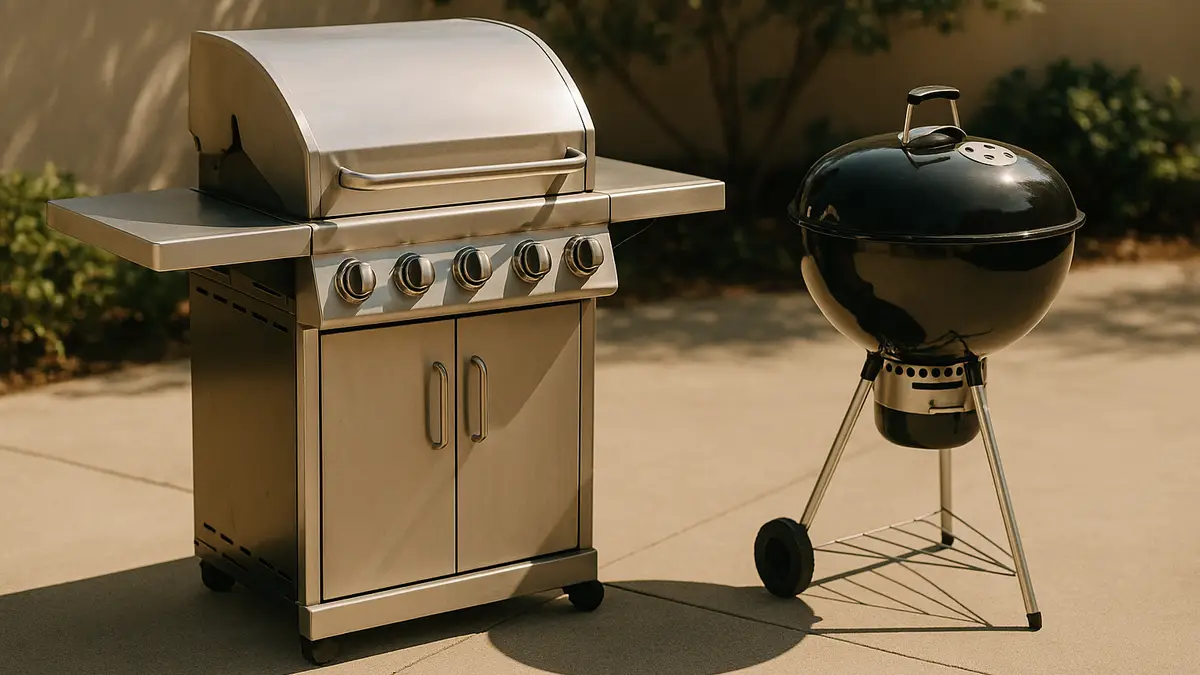
Gas versus charcoal is the oldest argument in backyard cooking, and it’s really a tradeoff between two things: how much flavor you want to chase and how much time you want to spend chasing it. Neither answer is wrong; the right one just depends on how you actually cook on a random weeknight versus a weekend cookout. Here’s the honest breakdown, plus where natural gas fits if you’re considering a permanent line hookup.
What’s the actual difference between gas and charcoal grilling?
A gas grill burns propane or natural gas through metal burners under a heat-diffusing plate or lava rocks, giving you instant, adjustable, consistent heat. A charcoal grill burns lit charcoal directly beneath the food, producing higher peak temperatures at the grate and genuine smoke contact, but with heat that’s harder to fine-tune and fuel that needs relighting for a second cook.
| Factor | Gas grill | Charcoal grill |
|---|---|---|
| Time to cooking heat | 10-15 minutes | 15-20 minutes (chimney) |
| Flavor | Good, less smoky | More smoke flavor, more variable |
| Temperature control | Precise, instant | Manual, via vents and coal placement |
| Cleanup | Minimal | Ash removal after each cook |
| Typical price | $200-2,000+ | $100-800 |
| Fuel cost per cook | Low (propane/gas) | Low-moderate (charcoal) |
Does charcoal actually produce better flavor?
Partly, and it’s worth being precise about why. Some of what people credit to charcoal is just higher sear temperature, charcoal fires commonly run hotter at the grate than a gas burner, which browns meat more aggressively. The rest is real: direct smoke and char contact adds flavor compounds gas simply doesn’t produce at the same intensity. If maximizing smoke flavor is the goal, a kamado or offset smoker (both charcoal or wood-fueled) goes further than either a standard gas or charcoal kettle grill; see our full kamado vs offset vs pellet vs gas comparison.
Is natural gas different from propane for grilling?
Yes, and it’s a separate decision from gas vs charcoal. A natural gas grill connects to your home’s gas line and never runs out mid-cook, but it requires a professional hookup and the grill has to stay near that line, sacrificing portability entirely. A propane grill runs on refillable or exchangeable tanks, giving up the unlimited-fuel convenience for the ability to move the grill anywhere. Most grills sold as “gas grills” are propane by default and either come natural-gas-ready or support a conversion kit; check before assuming compatibility. Our propane tank and cylinder guide covers tank sizing and how long a standard tank actually lasts.
Which one is easier to live with day to day?
Gas, without much argument. Push-button ignition, a knob-controlled flame, and no ash to clean up make gas the lower-friction choice for cooking dinner on a random Tuesday. Charcoal asks more of you every single time: lighting a chimney (about 100 briquettes, ready in 15-20 minutes), managing airflow through vents, and cleaning out ash afterward. That friction is exactly why charcoal grilling skews toward people who see the process itself as part of the appeal, not just a means to dinner.
Which one costs less over several years of ownership?
Upfront price favors charcoal (a good kettle grill runs $100-200 versus $200-800+ for a comparable gas grill), but the gap narrows over time depending on how often you cook. Gas grills need occasional burner and igniter replacement but otherwise low maintenance. Charcoal grills need almost no mechanical upkeep since there’s nothing to break, but you’re buying fuel (charcoal or briquettes) every single cook rather than a tank that lasts 18-20 hours of cook time. Heavy weekly grillers often find propane cheaper per cook than charcoal once you account for how many bags of briquettes a season actually burns through; occasional grillers rarely cook enough to make the fuel cost difference meaningful either way.
What about safety and setup?
Gas grills carry a small risk of gas leaks at hose connections, worth checking with a soapy water test on the fittings once a season, but otherwise present no open-flame ash hazard once the lid is closed. Charcoal grills produce hot ash that needs to cool fully, usually 24-48 hours, before disposal, and the ash pan or catch tray needs regular emptying to keep airflow clean. Neither is meaningfully more dangerous than the other with basic care, but charcoal demands more attention to hot-ash handling around kids and pets.
Which one should you actually buy?
Buy gas if convenience and speed matter more than maximum flavor, you cook on weeknights as often as weekends, and you want push-button reliability. Our best budget grills under $300 guide covers solid entry gas options.
Buy charcoal if you’re willing to spend the extra 20-30 minutes per cook for noticeably better sear and smoke flavor, and you don’t mind ash cleanup. A basic charcoal kettle is also usually the cheapest genuinely good grill you can buy, often under $200.
Consider natural gas specifically only if the grill will live in one permanent spot, near an existing or installable gas line, and you cook often enough that never buying propane tanks again is worth the upfront hookup cost.
If your decision spans more than these two fuel types, our best grill buying guide breaks the full field down by budget rather than fuel type alone, which is often the faster way to land on a specific model.
Frequently asked questions
Quick answers to what readers ask us most
Does charcoal really taste better than gas?
Most of what people call charcoal flavor actually comes from fat and juices dripping onto hot coals and vaporizing back into the food, an effect gas grills also produce, just less intensely due to lower average grate heat. Direct wood or charcoal smoke contact adds a real, separate flavor gas can't replicate.
Can I convert a propane grill to natural gas?
Many grills support a conversion kit that swaps the regulator and orifices, but not all models are rated for it. Check your grill's manual or manufacturer site before attempting a conversion, since an incorrect setup is a safety issue.
Which is cheaper to run, gas or charcoal?
Natural gas is the cheapest per cook if you already have a line, since you're billed through your home gas account rather than buying tanks or bags. Propane and charcoal run fairly close per cook, with charcoal grills usually cheaper to buy upfront.
How long does a propane tank last on a gas grill?
A standard 20 lb tank holds about 4.7 gallons and runs roughly 18-20 hours on a typical 2-burner grill at high heat. See our propane tank guide for exchange versus refill options.