
Kamado vs Offset vs Pellet vs Gas: Full Comparison
Kamado, offset, pellet, and gas grills compared on fuel, cost, flavor, and skill needed, with a chart and price bands to help you pick the right one.
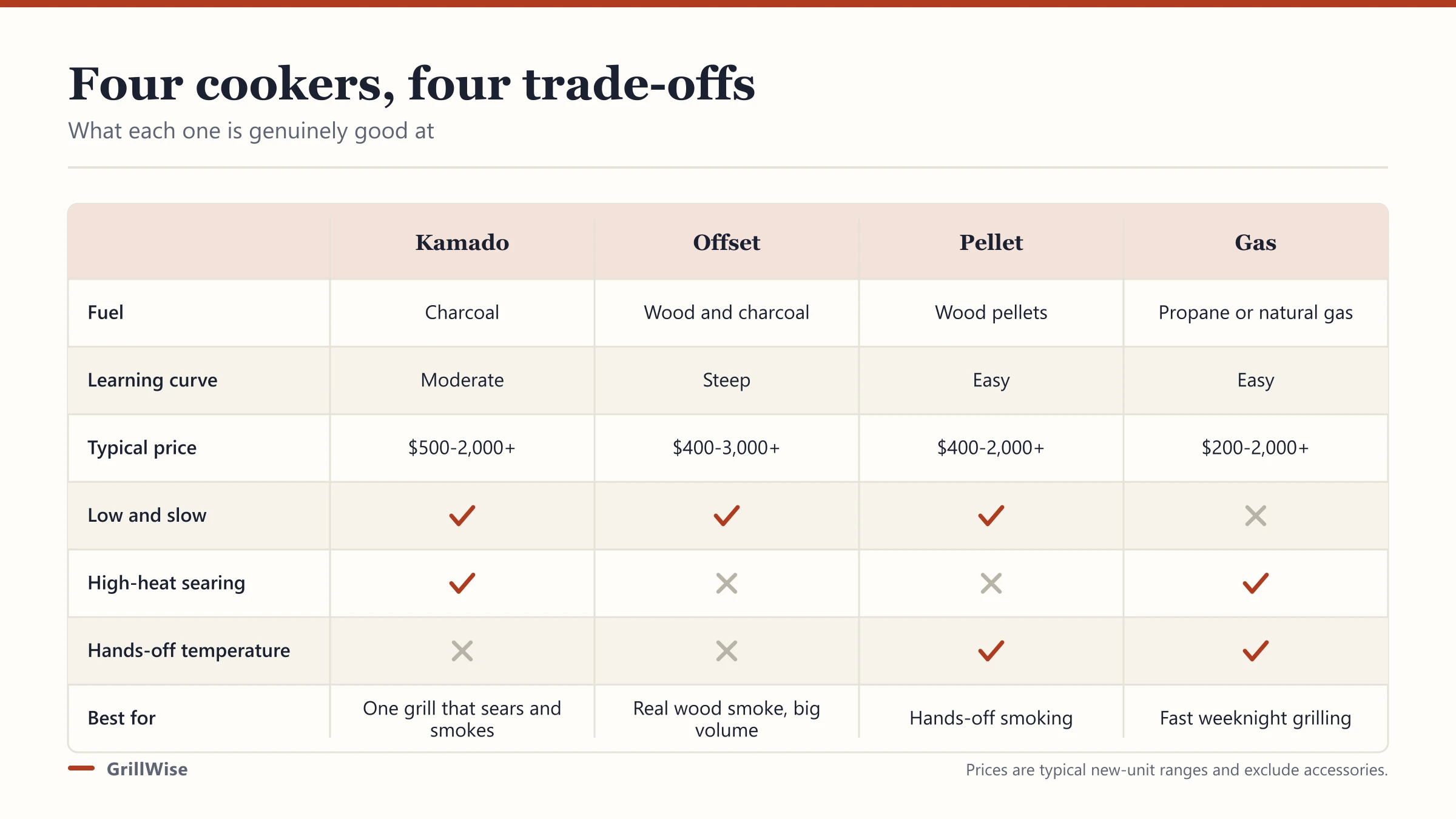
Four grills, four completely different ownership experiences. A kamado and an offset smoker both burn real fuel and reward patience; a pellet grill automates that patience away; a gas grill skips smoke flavor entirely in exchange for a 10-minute dinner. Here’s how they actually compare, not in theory but in what you’ll be doing in your backyard at 6pm on a Tuesday.
What’s the real difference between kamado, offset, pellet, and gas grills?
A kamado grill is a thick-walled ceramic or enamel-coated cooker shaped like an egg that uses charcoal for both searing and multi-hour smoking. An offset smoker is a horizontal steel chamber with a separate firebox attached to one side, built specifically for low-and-slow wood smoking on large cuts. A pellet grill is a hopper-fed, auger-driven cooker that burns compressed wood pellets and holds a set temperature automatically through a digital controller. A gas grill runs on propane or natural gas through burners under a cooking grate, built for fast, direct-heat cooking rather than smoking.
| Type | Fuel | Learning curve | Typical price | Best for |
|---|---|---|---|---|
| Kamado | Charcoal | Moderate | $500-2,000+ | One grill that sears and smokes |
| Offset smoker | Wood/charcoal | Steep | $400-3,000+ | Real wood smoke, big cook volume |
| Pellet grill | Wood pellets | Easy | $400-2,000+ | Hands-off smoking with real wood flavor |
| Gas grill | Propane/natural gas | Easy | $200-2,000+ | Fast weeknight grilling, easy cleanup |
How does a kamado grill cook differently from the others?
The thick ceramic walls hold heat with very little fuel and very little temperature swing, so a kamado can sear a steak at 700F+ or hold 225F for an overnight brisket on the same load of charcoal. That range is the whole appeal. The tradeoff is a learning curve on airflow control (top and bottom vents) and a heavier, pricier unit than a comparable kettle grill. Our kamado grill buying guide covers sizing from the 13-15 inch compact to the 24 inch XL.
Why do pitmasters still choose offset smokers over pellet grills?
An offset smoker burns actual splits of wood in a separate firebox, and the smoke has to travel across the full length of the cooking chamber before it hits the meat, which is exactly what builds the deep bark and pronounced smoke ring competition cooks chase. It also demands the most attention of any grill type here: feeding the fire every 30-45 minutes, chasing temperature swings, and reading smoke color. Chamber size matters more than most buyers expect; our offset smoker buying guide breaks down small, medium, and large chambers by how much meat they actually hold.
Is a pellet grill basically a smoker on autopilot?
Close to it. A pellet grill’s auger feeds pellets into a firepot at a rate set by its digital controller, which reads chamber temperature and adjusts feed rate to hold it steady, often within 10-15 degrees. That takes fire management off your plate entirely, which is why pellet grills have become the default choice for people who want real wood smoke without standing over a fire for 12 hours. Our best pellet grill vs smoker comparison goes deeper on which pellet models compete directly with cabinet smokers.
When does a gas grill beat all three?
On any weeknight where you want dinner on the table in 20 minutes with minimal cleanup. Gas grills heat up in 10-15 minutes, hold a steady direct-heat temperature with a turn of a knob, and produce no ash. What they don’t do is add wood smoke flavor, which is the entire reason the other three exist. For a straight fuel-type comparison rather than a full four-way, see gas vs charcoal grill.
Which one should you actually buy?
Buy a kamado if you want one grill that handles both weeknight steaks and weekend briskets, and you’re willing to pay $500-2,000+ for that flexibility. Who it’s not for: anyone who wants to grill dinner and be done in 15 minutes without managing vents.
Buy an offset smoker if smoke flavor and the process itself matter more than convenience, and you have the yard space and the hours to feed a fire. Who it’s not for: apartment or small-patio owners, and anyone who travels most weekends and can’t babysit a cook.
Buy a pellet grill if you want smoked food most weekends without learning fire management, and you’re comfortable depending on electricity and a pellet supply. Who it’s not for: anyone chasing the most intense possible smoke flavor, since pellet smoke is milder than a wood-fed offset.
Buy a gas grill if speed and low maintenance matter more than smoke flavor, and most of your cooking is burgers, chicken, and steaks rather than 12-hour cooks. Who it’s not for: anyone whose main goal is learning to smoke brisket or ribs.
How much upkeep does each one actually need?
Gas grills need the least: a grate scrape after each cook and a burner check once a season. Kamados need occasional gasket replacement (the felt seal around the lid wears over years of heat cycling) and ash removal every few cooks. Pellet grills need the firepot cleaned of ash buildup regularly and the auger kept dry, since damp pellets jam the feed system. Offset smokers need the most: a wipe-down after every cook to prevent rust on bare steel, and a full seasoning routine before first use. If you’re leaning offset, our offset smoker seasoning and maintenance guide covers that routine in full.
If your budget spans more than one of these categories, our best grill buying guide breaks recommendations down by exact price tier rather than fuel type, which is often the more useful lens once you know roughly what you want to spend.
Frequently asked questions
Quick answers to what readers ask us most
Which is better for beginners, pellet or gas?
Gas is faster to learn for direct grilling, since it is just heat and a lid. Pellet grills are nearly as easy for smoking specifically, because the controller holds temperature for you, but they're a different skill (patience, not flame management).
Can a kamado grill replace a smoker?
Yes, for most home cooks. A kamado holds low, steady heat for hours on a single load of charcoal, which covers 90% of what a dedicated offset smoker does. See our kamado grill buying guide for sizing.
Is an offset smoker worth it over a pellet grill?
Only if you want to manage a real wood fire by hand and believe that effort changes the flavor, which many pitmasters do. If you want consistent results with less babysitting, a pellet grill gets you 90% of the smoke flavor for a fraction of the attention.
What's the cheapest way to start smoking meat?
A kamado grill in the 18-19 inch size, since it doubles as your everyday grill and a smoker, avoiding a second purchase. Entry kamados start around $500, well under a comparable offset or pellet setup with similar capacity.